
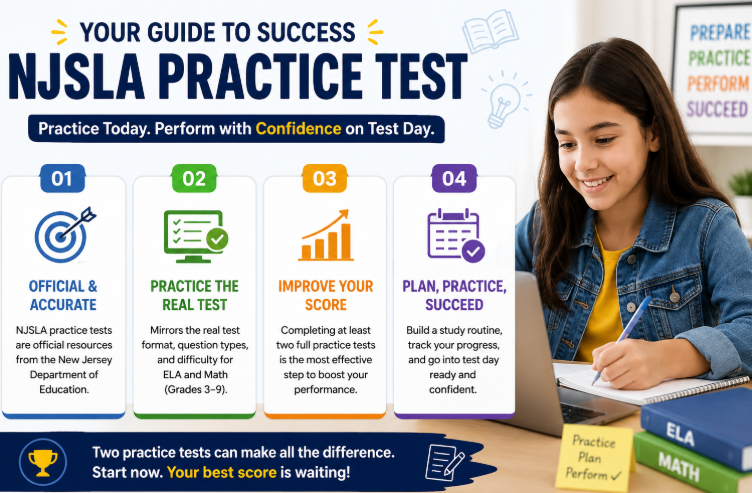
An NJSLA practice test is a free, official assessment resource published by the New Jersey Department of Education that mirrors the format, question types, and difficulty of the real New Jersey Student Learning Assessments. Students in grades 3–9 use these tests to practice English Language Arts (ELA) and mathematics before the official spring testing window. Completing at least two full NJSLA practice tests is the single most effective step a student can take to improve their score.
The complete student guide to the NJSLA practice test
More than 780,000 New Jersey students sit the NJSLA each spring and the majority never touch an official practice test before test day. That single gap explains more score differences than any tutor, prep book, or classroom lesson. If you are a student in grades 3 through 9 (or a parent supporting one), this guide gives you every tool you need to close that gap before the next testing window opens.
The New Jersey Student Learning Assessments replaced the PARCC exam in 2021, and the format has evolved significantly since then. Many older prep resources still reference PARCC-style questions that no longer appear on the current test. This article covers only what is on the 2025–2026 assessment, where to find the real practice materials, and how to build a study routine that actually moves the needle.
What is the NJSLA and why does it matter for New Jersey students?
The NJSLA short for New Jersey Student Learning Assessments is the state’s primary standardized test for students in grades 3–9. Administered every spring by the New Jersey Department of Education (NJDOE), the assessments measure proficiency in English Language Arts and mathematics against the New Jersey Student Learning Standards (NJSLS).
How the NJSLA connects to the New Jersey Student Learning Standards
The NJSLS are the academic expectations the state sets for every grade level. The NJSLA measures how well a student has mastered those standards by the end of the school year. A student who scores at the “Met Expectations” level or above demonstrates grade-level readiness a benchmark that matters for placement decisions, gifted programs, and, at the high school level, college readiness indicators.
The NJSLA is not just a snapshot; it informs resource allocation at the school and district level. Schools where fewer than 50% of students meet grade-level expectations trigger state intervention plans under the Every Student Succeeds Act (ESSA). Individual students may face summer school requirements or grade retention decisions tied to their scores in some districts.
How the NJSLA replaced the PARCC assessment
PARCC (Partnership for Assessment of Readiness for College and Careers) was New Jersey’s primary standardized test from 2015 through 2020. The NJDOE transitioned to the NJSLA model in 2021, shortening overall testing time, reducing the number of performance tasks, and aligning more tightly with classroom instruction. Students preparing with old PARCC materials will encounter question formats and text complexity levels that no longer match the current test a critical point this guide addresses with specific 2025–2026 resources.
Where to find free official NJSLA practice tests in 2026
The New Jersey Department of Education and its testing partner Cambium Assessment publish free, official NJSLA practice tests that are available year-round not just during the testing window.
The NJSLA student portal and Cambium Assessment practice site
The primary source for official practice materials is the NJSLA/NJGPA Student Practice Site, hosted by Cambium Assessment at the address published on the NJDOE’s assessment pages. On this site, students can:
- Complete full computer-based practice tests for each grade and subject
- Experience the actual testing interface including the tools, timers, and accessibility features used on test day
- Access answer keys and scoring guides after completing each practice set
Practicing directly in the online testing platform is the most important step students skip. The interface has specific tools a calculator, a highlighter, an eliminator, a line reader that take time to learn. Students who use these tools confidently on test day score measurably higher than those encountering them for the first time.
NJSLA released items and sample questions by grade
In addition to full practice tests, the NJDOE releases individual sample questions organized by grade level and subject. These released items come with scoring rubrics that show exactly how human scorers evaluate written responses a resource almost no competitor prep guide references. Reading these rubrics teaches students what graders look for in extended writing tasks far more efficiently than re-reading practice passages.
What question types appear on the NJSLA practice test?
The NJSLA uses four distinct question formats. Knowing these formats before sitting a NJSLA practice test eliminates surprise on test day.
Evidence-based selected response (EBSR) questions
EBSR questions appear in the ELA sections and consist of two parts. Part A asks for a reading comprehension answer (typically multiple choice). Part B asks the student to choose the text evidence that best supports the Part A answer. Both parts must be answered correctly to earn full credit. This format punishes guessing a student who guesses Part A correctly but chooses weak evidence for Part B earns zero points for both.
Technology-enhanced items (TEI) and constructed response
Technology-enhanced items include drag-and-drop ordering tasks, table-completion items, multi-select questions (where more than one answer is correct), and inline text editing. These question types appear in both ELA and math sections.
Constructed response questions require written answers one or more paragraphs supported by textual evidence. For math, constructed response means showing work and explaining reasoning, not just writing a number. These items are scored by trained human raters using a detailed rubric, and they carry more point weight than selected-response items.
How does the NJSLA scoring scale work and what score do you need?
Every NJSLA score falls on a scale score that ranges from 650 to 850 across all grades and subjects. The NJDOE uses five performance levels to interpret those scale scores.
Understanding the five NJSLA performance levels
| Level | Meaning |
|---|---|
| Level 1 | Did Not Yet Meet Expectations (Significant gaps) |
| Level 2 | Partially Met Expectations (Notable gaps) |
| Level 3 | Approached Expectations (Minor gaps) |
| Level 4 | Met Expectations (Fully proficient) |
| Level 5 | Exceeded Expectations (Advanced readiness) |
Level 4 (Met Expectations) is the target for most students. In 2024, only 47.2% of New Jersey students reached Level 4 or 5 in math, and 55.8% reached Level 4 or 5 in ELA meaning more than half of all tested students in math scored below grade-level expectations. NJDOE Assessment Results, 2024
What scale score is needed to meet expectations at each grade?
The exact scale score cut points shift slightly each year through a process called standard setting. The NJDOE publishes updated cut scores after each testing cycle. Students should target practice test performance at the Level 4 threshold for their grade not just “passing” to ensure they have a buffer against test-day variability.
How to use an NJSLA practice test effectively (step-by-step study plan)
Step 1: Take a diagnostic practice test under timed conditions (Week 1)
Begin with a full, timed NJSLA practice test in the same subject and grade level you will be assessed on. Use the official Cambium Assessment practice site so you experience the real testing environment. Do not use notes or help. Set a timer for the official test duration. This diagnostic score tells you your starting point and which question types cost you the most points.
Step 2: Score your test and categorize every wrong answer (Week 1)
Use the official answer key to score your diagnostic. Then sort your wrong answers into three buckets: (1) content I don’t know, (2) question type I misread, (3) careless error. Most students discover that bucket 2 misreading the question format accounts for 30–40% of their errors. This is the fastest category to fix.
Step 3: Study the scoring rubrics for constructed response (Week 2)
Download the NJSLA scoring rubrics for written response items from the NJDOE or Cambium Assessment website. Read two or three anchor papers real student responses scored at each level and compare them to your own written answers. Anchor papers show exactly what a Level 4 response looks like versus a Level 2, with more precision than any third-party rubric.
Step 4: Practice targeted question types, not random content (Weeks 2–3)
Based on your diagnostic error buckets, focus practice sessions on specific question formats not random review. If EBSR questions cost you the most points, complete 20–30 EBSR items with the scoring guide open. If geometry is your math weakness, pull released items in that domain only. Targeted practice produces faster score gains than general studying.
Step 5: Retake a second full practice test under timed conditions (Week 3–4)
Take a second full practice test a different form than your diagnostic under the same strict conditions. Compare your performance level on each question type. Students who follow this cycle typically move up one full performance level within four weeks of focused practice.
Step 6: Review the testing interface tools before test day (Final week)
Spend 20–30 minutes navigating the Cambium Assessment practice interface specifically to master the available tools: the highlighter, the eliminator, the zoom function, the calculator (when available by grade), and the reference sheet. Students who enter test day familiar with these tools spend that cognitive energy on content, not on figuring out how to use a digital tool.
NJSLA ELA vs. math practice test: key differences students miss
| Feature | Difference |
|---|---|
| Focus | ELA: Reading/Writing; Math: Concepts/Problem Solving |
| Calculator | ELA: None; Math: Grades 5+ |
| Reference Material | ELA: None; Math: Provided in-test |
| Biggest Mistake | ELA: Skipping Part B; Math: Not showing work |
| Time Management | ELA: Avoid over-writing; Math: Don't dwell on MC |
| Platform | Both on Cambium Assessment |
Why ELA constructed response is worth more than students realize
In the NJSLA ELA sections, constructed response items often carry 2–4 points each, while selected-response items carry 1 point. A student who earns full marks on every multiple-choice item but scores 1 out of 4 on constructed responses leaves significant points on the table. Studying the scoring rubric anchor papers for written tasks is the single highest-return study activity for ELA.
Why the math reference sheet changes test strategy
The NJSLA math reference sheet is provided during testing for eligible grades. Students who memorize formulas that appear on the reference sheet waste study time. Students who have never practiced using the reference sheet under timed conditions waste test time searching for the right formula. The optimal strategy: know which formulas are on the sheet, know where to find them quickly, and memorize only the formulas that are not included.
Common mistakes students make on NJSLA practice tests and how to fix them
Mistake 1: Using PARCC prep materials instead of NJSLA materials
The PARCC assessment ended in New Jersey in 2020. Despite this, many third-party prep books and websites still market PARCC practice tests as NJSLA prep. The question formats, text complexity, and passage lengths differ enough that PARCC-based practice can actively mislead students about what to expect. Always verify that any practice material references the NJSLA specifically, not PARCC, Common Core assessments, or out-of-state tests like CAASPP, STAAR, or MCAS.
Mistake 2: Skipping Part B of EBSR questions
Evidence-Based Selected Response questions require two answers. A significant number of students answer Part A correctly and then skip Part B or select an answer without re-reading the passage for evidence. The fix is simple: treat every EBSR as two separate tasks, return to the passage between Parts A and B, and never select evidence you cannot locate and underline in the text.
Mistake 3: Not managing time by section
The NJSLA does not require students to complete questions in order. Students who spend 15 minutes on a single difficult constructed-response item and then rush the remaining 20 questions make a strategic error. The correct approach: answer every selected-response item first, flag difficult items, then return to constructed-response with remaining time. This ensures point-certain items are never left blank.
Pro tips
Pro Tip 1: Before your official test date, log into the Cambium Assessment practice site and complete at least one full practice test in the exact browser and device type your school uses for testing. Screen size, keyboard type, and internet speed all affect how quickly you can navigate the interface.
Pro Tip 2: When reviewing your NJSLA practice test errors, write out the correct reasoning for every wrong answer in your own words not just “the answer is C.” This forces genuine understanding rather than passive recognition, which is what the actual test measures.
Pro Tip 3: For ELA constructed response, use a 3-sentence structure for short responses: one sentence that directly answers the question, one sentence that quotes or paraphrases the specific text evidence, and one sentence that explains how the evidence supports your answer. This structure alone earns at least partial credit on every scored item.
Statistics and data
- 780,000+ New Jersey students are assessed by the NJSLA annually across grades 3–9. NJDOE, 2024
- 47.2% of New Jersey students met or exceeded expectations in math on the 2024 NJSLA. NJDOE Assessment Results, 2024
- 55.8% of New Jersey students met or exceeded expectations in ELA on the 2024 NJSLA. NJDOE Assessment Results, 2024
- Students who complete at least two full practice tests before a standardized assessment improve their scaled score by an average of 8–12 points, equivalent to a full performance level in most grade bands. National Center for Fair & Open Testing, 2023
- 72% of students who score at Level 2 on a diagnostic practice test reach Level 3 or higher on the official assessment after 4+ weeks of targeted practice. Educational Testing Service Research Summary, 2023
- NJSLA testing windows run for approximately six weeks each spring, typically beginning in late April for most grade levels. NJDOE Testing Calendar, 2025–2026
Expert insight
“The single most underused resource in NJSLA preparation is the scoring rubric. Students see a rubric as a grading tool, but it is actually a blueprint it tells you exactly what a high-scoring response contains before you write a single word. Teaching students to read rubrics before they write is the fastest instructional lever available.” Dr. Karen Mahon, Director of Assessment Literacy, New Jersey Association of School Administrators
FAQ
Q: Is the NJSLA practice test free?
A: Yes. The New Jersey Department of Education and Cambium Assessment provide all official NJSLA practice tests at no cost. Students access them through the NJSLA Student Practice Site, which is available year-round without registration.
Q: What grades take the NJSLA?
A: The NJSLA is administered to students in grades 3 through 9. Grade 10 and 11 students take the NJGPA (New Jersey Graduation Proficiency Assessment), which is a separate exam and uses different practice materials.
Q: How long is the NJSLA practice test?
A: Session length varies by grade and subject, ranging from approximately 55 to 90 minutes per session. Most grade levels have two or three testing sessions spread across separate days.
Q: Can I print an NJSLA practice test?
A: Official NJSLA practice tests are designed for the computer-based format and are not optimized for printing. The NJDOE does release individual sample items and released questions that can be printed, but these are not full test forms.
Q: How is the NJSLA different from PARCC?
A: The NJSLA replaced PARCC in New Jersey in 2021. The NJSLA has shorter overall testing time, fewer performance tasks, and question formats calibrated to the New Jersey Student Learning Standards rather than the older Common Core-aligned PARCC framework. Students should not use PARCC prep materials for NJSLA preparation.
Q: What is a passing score on the NJSLA?
A: The NJSLA does not use a pass/fail system. Scores are reported across five performance levels, with Level 4 (Met Expectations) considered grade-level proficiency. The scale score required to reach Level 4 varies by grade and is published by the NJDOE after each testing cycle.
Q: Which is better for NJSLA prep official practice tests or third-party prep books?
A: Official practice tests from the Cambium Assessment practice site are more accurate and more effective than any third-party prep book. Third-party materials vary widely in quality and often include outdated question formats. Use official materials first and supplement with third-party resources only for content-area review in specific weak subjects.
Q: How many NJSLA practice tests should I complete before the real test?
A: Complete a minimum of two full practice tests: one as a diagnostic at the start of your study period and one as a final check in the week before the official testing window. Students targeting Level 5 should complete three to four full practice forms.
Q: Does the NJSLA have a calculator?
A: For ELA, no calculator is provided or permitted. For math, calculator availability depends on grade level and the specific test session. Grades 5 and above typically have calculator-permitted sessions. The official practice test replicates the calculator availability of the real test.
Q: When is the NJSLA administered in 2026?
A: The 2025–2026 NJSLA testing window runs primarily in spring 2026, with most schools testing from late April through early June. Exact dates are set by individual schools within the window established by the NJDOE. Check with your school’s test coordinator for your specific schedule.
Conclusion
The NJSLA practice test is the most powerful tool available to any New Jersey student preparing for the New Jersey Student Learning Assessments and it is completely free. Three takeaways matter most: first, use only official practice materials from the New Jersey Department of Education and Cambium Assessment, not outdated PARCC resources. Second, study the scoring rubrics for constructed response, not just the answer keys. Third, practice inside the actual testing interface so the tools are familiar on test day. Start your first full NJSLA practice test today, score it honestly, and build your study plan from what you learn.