⚡ Key Takeaways
- The Digital SAT Math section contains 44 questions across two 35-minute adaptive modules.
- Hard questions (positions 18–22) combine Algebra, Advanced Math, and Geometry/Trigonometry in a single problem.
- Only 1–2% of test-takers earn a perfect 800 on SAT Math.
- Missing 5–7 questions typically results in a score around 700 on SAT Math.
- The Desmos calculator inside the Bluebook app is powerful but some hard questions are designed to trip up students who rely on it blindly.
- Strong Module 1 performance unlocks a harder Module 2, which is required to access the 750–800 score range.

Why Hardest SAT Math Questions Matter
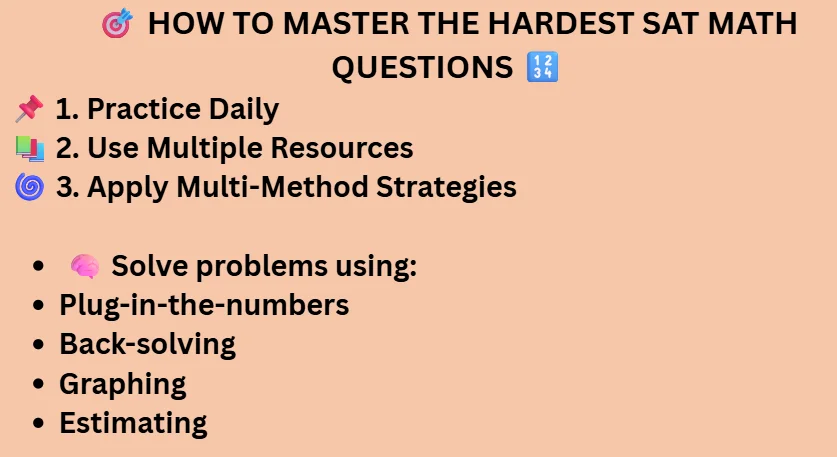
Many Difficult and Hardest SAT Math Questions Come in the SAT. To solve these hard problems, students must practice the hardest SAT Math questions daily. They must explore multiple sources and get familiar with the multi-method concept to solve each math problem. Students must know how to break the large-step math problem and implement their sum on the broken output for each step.
What Makes an SAT Math Question Officially “Hard”?
In the Digital SAT, question difficulty is determined by the percentage of students who answer correctly during field testing. Hard questions — classified at the “difficult” level by the College Board — appear at positions 18 through 22 in each module. These problems stand apart because they require students to apply multiple math concepts simultaneously rather than a single formula. A typical hard question might combine quadratic functions with systems of equations or blend trigonometric identities with circle geometry. Recognizing this pattern during SAT test prep is the first step toward breaking through score plateaus.
Sample SAT Math Questions: Practice with the Hardest Ones
Students must practice the Sample SAT Math Questions daily to solve the hardest SAT Math Questions. They must use different sources like SAT Practice Tests, SAT Math books, and other online resources. This is because these resources provide the hardest SAT Math Questions, so by practicing these hardest sample problems, the student will get good marks in the SAT Math Section.
Solving the challenging problems of Digital SAT math requires deep knowledge and the expertise to solve the hardest questions. By practicing the student daily through different sources, they will know the SAT Math Question Types used in the actual SAT Math questions. They will know the implementation of algebra, geometry, and other Advanced Mathematical analyses. Students must practice Problem-Solving Techniques to get good marks on the SAT Math.
Which Official Sources Provide the Best Hardest SAT Math Practice Questions?
The single most reliable source for authentic hardest SAT Math problems is the College Board’s official Bluebook app, which hosts six full-length Digital SAT practice tests at no cost. Each test replicates the real multistage adaptive testing format, meaning students experience the same difficulty routing they will on test day. Beyond Bluebook, Khan Academy’s SAT prep partnership with College Board offers personalized practice linked to your actual PSAT or SAT scores. Third-party platforms such as PrepScholar, PrepMaven, and LearnQ.ai supplement official materials with additional challenging problems and step-by-step explanations, making them valuable for students targeting a 750+ SAT Math score.
How Does the Digital SAT Adaptive Testing Model Work?
The Digital SAT uses a multistage adaptive design that directly affects which hard questions you see and your maximum possible score. Here is how it works in plain terms: the SAT Math section is split into two 35-minute modules of 22 questions each. Your performance on Module 1 determines the difficulty level of Module 2.
| Module 1 Performance | Module 2 Result |
|---|---|
| Strong (few errors) | Harder Module 2 → 750–800 score possible |
| Average | Standard Module 2 → ~650–720 ceiling |
| Weak (many errors) | Easier Module 2 → score capped below 650 |
This means that careless mistakes early in the test carry an outsized penalty. A student who rushes through the first five questions of Module 1 and misses two could be routed to an easier second module permanently limiting their score no matter how well they perform afterward. The section-adaptive testing structure is one of the most misunderstood aspects of the Digital SAT, and understanding it is essential for any student serious about SAT score improvement.
SAT Math Practice Questions: How to Prepare for the Hardest Questions
Practicing the SAT Math Practice questions from different sources will help tackle every type of difficult math question in the SAT Math Section. A student who wants to get a good SAT Math Score must practice and give the maximum time to solve Advanced Math Questions.
Students can also prepare themselves for the SAT Math modules through online resources. There are a lot of websites that provide authentic SAT Math Study Guides to solve the hardest problems of math problems. To solve the hardest SAT Math problems, the student must follow an authentic and well-structured SAT Math Plan to grasp the maximum math concepts in very little time.
What Is the Most Effective SAT Math Study Plan for Hard Questions?
An effective SAT Math study plan targeting the hardest questions should be built around four phases: diagnostic assessment, concept mastery, timed practice, and error analysis. Begin by taking a full-length Bluebook practice test to identify your weakest content domains whether that is Advanced Math, Problem Solving and Data Analysis, or Geometry and Trigonometry. Next, use targeted resources to master the underlying concepts before returning to full test simulations. Students who follow this structured approach rather than random practice consistently show greater SAT score improvement in shorter time frames. Research from College Board shows that students who practice for 20+ hours using official materials improve their Math scores by an average of 40 points.
Students must prepare themselves for the math section using the new method, a Digital SAT Format. Students must know how the question typically changes the SAT Question Difficulty types and the SAT Test Structure strategies.
Digital SAT math questions present the question in a new way and use an interactive method. By adopting this environment and digitally solving the math questions, the students will perform well in the actual SAT Math Section because they have already solved the questions in this environment.
Moreover, the Digital SAT math sections also improve Test Timing Management for the Complex Word Problems of SAT Math. If students don’t grasp the hardest questions pre-Digital SAT Math portion, then they will solve the hardest math problems in the actual SAT Math Section Goals.
How Is the Digital SAT Math Section Structured in 2026?
The Digital SAT Math section in 2026 consists of 44 questions total split into 33 multiple-choice questions and 11 student-produced response (grid-in) questions. Students have access to the built-in Desmos graphing calculator throughout both modules via the Bluebook app. The four tested content domains and their approximate test weight are shown below:
| Content Domain | Approx. % of Test |
|---|---|
| Algebra | ~35% |
| Advanced Math | ~35% |
| Problem Solving & Data Analysis | ~15% |
| Geometry & Trigonometry | ~15% |
Understanding this distribution is critical for SAT math preparation. With Algebra and Advanced Math together accounting for roughly 70% of questions, students who master these two domains gain the most ground. Linear equations and inequalities, quadratic equations, exponential functions, and polynomial expressions are the workhorses of the hardest Digital SAT math questions.
Top 10 Hardest SAT Math Questions You Should Know
The Top 10 Hardest SAT Math Questions come from various advanced topics in math. They include Function Transformations, Advanced Functions, complex trigonometry, multi-step equations, and advanced geometry concepts. They are challenging parts of the SAT Math Question Placement. But by practicing, you can solve them efficiently.
Which Topic Categories Produce the Trickiest SAT Math Questions?
According to patterns observed across official College Board practice tests, the trickiest SAT Math question types consistently fall into these six categories:
- nonlinear systems of equations requiring substitution and factoring
- absolute value equations with domain restrictions
- circle equations in non-standard form that require completing the square before identification
- trigonometric function transformations involving period, amplitude, and phase shift
- exponential growth and decay word problems with compound percentage rates
- complex data interpretation questions involving two-variable statistics.
Students who systematically target each of these six categories during their SAT math prep rather than reviewing all topics equally make the fastest score gains.
“The hardest SAT math questions don’t rely on advanced math or obscure formulas they’re difficult because they test how well students think under pressure. Students who slow down, re-read what the question is actually asking, and eliminate answer choices deliberately perform far better than students who try to move quickly.”
SAT Instructor Insight, TestPrepKart (2026)
Algebra in SAT Math: Hard Questions to Practice
Algebra is a significant component of the SAT Math Section, often featuring some of the most challenging problems. Students should focus on mastering key algebraic concepts such as equations, inequalities, Function Notation, and Systems of Equations.
Practicing these topics through difficult problems will enhance both understanding and performance on test day. The algebra section is the most important part of the SAT Math section, and the most challenging part. Students must focus on the multivariable equations, inequalities, and complex functions, as well as the Systems Equations.
Tracking the hardest math problems is very beneficial because the student can solve them differently and practice them regularly, ensuring they will never face the hardest math problems.
What Are the Hardest Algebra Questions on the Digital SAT?
The most challenging algebra questions on the Digital SAT involve systems of linear equations with special conditions specifically, problems where the system has no solution or infinitely many solutions. These questions require students to compare coefficient ratios rather than solve mechanically. Another common trap: rational equations with domain restrictions, where students correctly solve the equation but fail to check whether the solution is excluded by the denominator. A third category multi-step linear word problems trips up students who set up the equation correctly but misidentify what the question is actually asking for. In all three cases, the underlying algebra is not exceptionally advanced; the difficulty comes from precision, careful reading, and a disciplined elimination strategy during the SAT Math section.
Hardest Problem in Math SAT
There are many hard problems in SAT Math, but the most famous ones include algebra, complex trigonometry, and complex function implementations. Identifying the hardest SAT Math Problem is very difficult because it varies from student to student. The student who practices and solves Complex Word Problems daily will never face the hardest math problems.
Besides all of these, most agree that the problems from the Complex Functions and the multi-variable equations are the most difficult math problems.
Why Are Circle Equation Problems Among the Hardest SAT Math Questions in 2026?
One of the most instructive examples of a genuinely hard Digital SAT Math question in 2026 involves circle equations in non-standard form. These questions present an equation like x² + 4x + y² − 6y = 12 and ask for the center or radius. Students who jump to the Desmos graphing calculator immediately hit a wall Desmos can plot the circle, but identifying the center requires completing the square for both the x and y terms first. This type of question is deliberately designed to test whether students understand the underlying geometry and algebra, or whether they are simply relying on technology. The College Board has increasingly included such problems in harder Module 2 versions of the Digital SAT, making conceptual understanding not just calculator skill the true differentiator between scores in the mid-600s and scores above 750.
Hardest SAT Math Problems and Desmos
Desmos is an excellent tool that is used to visualize the complex the hardest math concepts. This tool allows the student to explore the Functions, Inequalities, as well as expressions.
This is the best and most useful source to understand the complex and hardest math problems. This is also useful to understand the relation between the variables.
This not only allows us to solve math problems but is also a learning source for visualizing the solutions to complex problems efficiently and graphically. By using the Inequalities, the student is familiar with how the equation will change while changing the values.
When Should You Use Desmos and When Should You Put It Away?
The Desmos graphing calculator embedded in the Bluebook app is one of the most powerful tools available to Digital SAT test-takers but knowing when not to use it is equally important. Desmos excels at: graphing linear and quadratic inequalities, finding intersection points of systems of equations, verifying answer choices by plugging in values, and visualizing function transformations. However, Desmos becomes a trap when a problem requires completing the square, algebraic manipulation of rational expressions, or interpreting function notation conceptually. Students who train themselves to first classify a problem as “Desmos-friendly” or “algebra-first” before touching the calculator consistently outperform those who default to graphing everything. This strategic Desmos calculator use is one of the clearest separators between students scoring 650 and those scoring 750+ on the SAT Math section.
Digital SAT Math vs. Paper SAT Math: Key Differences
Students transitioning from older study materials to the current Digital SAT format need to understand what has changed. The most important shifts directly affect how hard questions are approached and timed.
| Feature | Digital SAT (2023–2026) |
|---|---|
| Total math questions | 44 (vs. 58 paper) |
| Calculator policy | Allowed throughout |
| Built-in tool | Desmos graphing app |
| Test structure | Adaptive (2 modules) |
| Score range | 200–800 |
| Time per module | 35 minutes each |
The reduction from 58 to 44 questions means each question carries more weight. Missing four questions in the Digital SAT has a proportionally greater impact than missing four on the older paper test. This makes accuracy over speed the dominant strategy particularly for students aiming for a 700+ SAT Math score.
How to Score 700+ on SAT Math
Reaching 700 or above on SAT Math requires consistent, strategic preparation rather than passive review. Here is a proven step-by-step approach used by high-scoring students:
- Take a diagnostic test. Use a full Bluebook practice test to identify your current SAT Math score and see which question types you miss most.
- Target your two weakest domains. Focus on Advanced Math and Algebra first, since together they make up ~70% of the test.
- Study by question type, not by module. Drill nonlinear systems, absolute value equations, and function transformations in focused sessions.
- Practice Desmos strategies. Learn exactly which problem types benefit from the Desmos graphing calculator and which require pure algebra.
- Review every missed question. For each error, identify whether it was a concept gap, a careless mistake, or a misread question then address the root cause.
- Simulate test conditions. Take at least three full timed practice tests before test day to build test timing management and stamina.
What Are the Most Common Mistakes on Hard SAT Math Problems?
Understanding where students go wrong on the hardest SAT Math questions is as valuable as knowing how to solve them. The most frequent errors fall into three categories:
| Mistake Type | Example |
|---|---|
| Misreading the question | Solving for x when the question asks for 2x + 1 |
| Skipping domain checks | Accepting a solution that makes a denominator zero |
| Over-relying on Desmos | Graphing a circle without completing the square first |
| Rushing Module 1 | Careless errors that cap score in the adaptive system |
| Ignoring answer choices | Not using elimination on multi-concept problems |
The most instructive pattern across high-scoring SAT test prep programs is this: students who make significant SAT score improvement are almost never learning brand-new math. They are eliminating the specific, repeatable errors listed above. Error analysis reviewing every wrong answer in detail is the highest-return activity in any Digital SAT Math study plan.
SAT Math Score Statistics You Should Know
📊 Key SAT Math Data Points (2025–2026):
- Only 1–2% of test-takers achieve a perfect 800 on SAT Math.
- At top engineering schools like MIT and Caltech, 75% of admitted students scored 780–800 on Math.
- A score of 750 requires missing only 2–3 questions across both modules.
- Missing 5–7 questions typically results in approximately a 700 score.
- Students who practice with College Board official materials for 20+ hours improve Math scores by an average of 40 points.
- The Digital SAT Math section contains 44 questions total 33 multiple-choice and 11 student-produced responses.