📌 Key Takeaways
- The SAT is administered by the College Board and has been fully digital since March 2024.
- Total test time is 2 hours 14 minutes with two sections: Reading & Writing and Math.
- Scores range from 400 to 1600; the 2025 average was approximately 1029.
- The Bluebook™ app is the official platform for all digital SAT administrations.
- Over 2 million students took the SAT from the Class of 2026
- The SAT uses multistage adaptive testing Module 2 difficulty adjusts based on Module 1 performance.
- Fee waivers are available for eligible low-income students through the College Board.
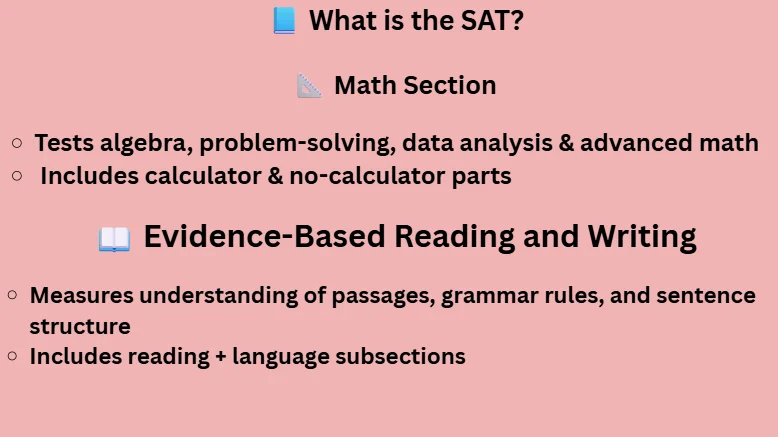
SAT is a standardized test, and it stands for Scholastic Aptitude Test. It is also special for students admitted to American colleges and universities. This test is an important part of college admission. It measures the students’ educational skills. It consists of two major parts: the math section and the evidence-based reading and writing section. SAT practice test prep will provide information on the SAT in the following categories.
SAT Writing Practice Test
SAT Reading Practice Test
History of the SAT Test
In 1899, college boards were created so that one exam was taken instead of the separate exams of the college. The first standardized test was conducted in 1901. The design of the SAT was inspired by the Army Alpha test created for soldiers during World War 1. This test was conducted for the first time in 1926.
SAT From 1930 To 1970
In the 1930s, Carl C. Briggs and Howard Kinsman sequenced this test with a new method and a change in the test. In 1933, Harvard University adopted this test for scholarship programs. In the 1940s and 1950s, the SAT system was administered by the Educational Testing Service (ETS).
The use of the SAT for admission to higher colleges and universities. In 1970, the importance of the SAT scores increased and made it important for admission to American colleges and universities. Some of the colleges also accept the ACT. You should explore the Difference between the SAT and the ACT.
SAT From 1974 To 1994
In 1974 there was made a sequence of scores was made to provide a chance for every student. In 1994, there were big changes in the state. Antonyms are finished in this test. A graph and a table were added in the maths section.
2005 To Onward
In 2005, significant changes were made to the SAT. The name of the SAT was changed to the Scholastic Assessment Test. Reading, writing, and mathematics parts were added, and a new essay section was introduced.
The total score increased from 1600 to 2400 (800 points for each section: reading, writing, and mathematics). In 2016, the SAT was redesigned to match the school curriculum, and the scoring system reverted to 1600 points.
The essay section became optional. In 2024, the College Board announced a shift to a digital format for the SAT, reducing the test duration to 2 hours. The two sections in this new format are Reading & Writing and Math.
What Is the Digital SAT Format and How Does It Work?
In short, the digital SAT is a computer-based version of the traditional exam, delivered through the Bluebook™ app the official College Board testing platform. Beginning with the March 2024 administration, all students worldwide take the standardized college admissions test on a device such as a laptop, tablet, or school-issued Chromebook. The device must have at least three hours of battery life and Wi-Fi capability, though the Bluebook app saves work locally so a dropped connection during the exam does not cause data loss.
The digital format is significantly shorter than the old paper test. Students complete the full exam in approximately 2 hours and 14 minutes compared to nearly 3 hours under the previous format without sacrificing measurement accuracy. Each question is tied to its own short passage, which means students spend less time reading long multi-question passages and more time demonstrating analytical thinking. There is a single 10-minute break between the Reading & Writing section and the Math section.
How Does SAT Adaptive Testing (Multistage Adaptive Testing) Work in 2025?
The answer is that the digital SAT uses multistage adaptive testing a format where your performance on Module 1 of each section determines the difficulty level of Module 2. If you answer most Module 1 questions correctly, you receive a harder Module 2 with a higher score ceiling. If your Module 1 performance is weaker, you receive an easier Module 2 with a lower maximum score. This means every student’s second module is personalized to their demonstrated ability level, making the 98-question test a more precise and efficient measurement tool than the older 154-question paper version.
Section-adaptive testing differs from question-level adaptive testing (used in assessments like MAP Growth), where each individual question changes based on the prior answer. The College Board‘s multistage model groups questions into sets, which makes the college readiness assessment feel more like a traditional exam while still adapting to each student’s skill level. An important strategic implication: performing strongly in Module 1 is critical, because it unlocks the high-difficulty Module 2 where the top scores become achievable.
SAT Exam Pattern 2026
There are three important parts to the exam.
Reading Passage Section
In the reading section, you are given paragraphs the read, and after reading the paragraphs ask questions about the paragraphs.
Writing and Language Section
You have to correct these mistakes in the sentences, like the correct use of grammar sentence, and the structure of the sentence, in the section on writing and language.
Mathematics
- Calculator section: In this section of the maths test, calculators are allowed. The questions of this section are commonly difficult and consist of big marks like multiplication and division.
- Non-calculator section: No calculator is allowed in this section. The questions in this section are very simple and easy. Adding and subtraction questions are asked in this section.
Digital SAT Exam Marks Distribution 2025
The SAT digital exam pattern 2025 consists of two parts. Reading, writing, and math. The time of the test is 2 hours and 14 minutes. There are 98 questions asked in the test. The scoring of every section is done on the 1600.
Digital SAT Exam Pattern 2026 with Score Range
You know that SAT scores have two sections. And the range of every section is 200 to 800. The range of the total scores is between 400 to 1600.
Digital SAT at a Glance: Format vs. Score
| Feature | Detail |
|---|---|
| Total Duration | 2 hrs 14 min |
| Total Questions | 98 |
| Sections | Reading & Writing, Math |
| Score Range | 400–1600 |
| Per Section Range | 200–800 |
| Adaptive Format | Multistage (Module 1 → 2) |
| Platform | Bluebook™ app |
| Calculator Allowed | All of Math section |
| Built-in Calculator | Desmos graphing tool |
| Essay Section | Not offered |
| Score Release | ~2 weeks post-test |
| Test Cost (2026) | $68 |
SAT Math Exam Pattern 2006
There are important topics added in the math exam section. Algebra, advanced math, data analysis, geometry trigonometry are topics of this section.
- Algebra: 36 percent of the questions are asked from this section. Different types of variations and two-variable questions are present. There are 13 to 15 questions asked in this section.
- Advanced Math: 35% of the questions are asked from the advanced math portion, which represents methods to solve complex problems. The number of questions in this section is 13 to 15.
- Geometry or Trigonometry: 15% of questions are asked from this section. Lines, Angles, Triangles, Areas, and volumes are present. 5 to 7 questions are asked in this section.
- Problem-solving and Data Analysis: 15% of questions are asked from this section. What amount of data is present on percentage ratios and varieties?
SAT Evidence-Based Reading and Writing Pattern
Different questions are asked about reading and writing on the SAT. In the section on reading and writing, it measures your reading and thinking skills.
- Reading and comprehension questions: You will have to read different paragraphs from this section. And after you will have to answer the questions asked in the paragraphs.
- Evidence-based questions: Evidence-based questions are those questions in which you have to find a line or part of the text that proves your answer is correct.
- Grammar and language questions: In this section, you will be able to fully focus on the grammar and the structure of the sentence and correct the mistakes.
- Revising and editing questions: In this section, you will have to make changes to the images so that images look clearer and better.
SAT Question Types in Reading and Writing
There are four parts to this section.
- Craft and structure: 28% of questions are asked from this section. Word meaning is asked in this section, and you will need to understand the relationship between the two texts. There are 15 to 13 questions in it.
- Information and ideas: This section is 26%. You must look at the important things in the test. This section consists of 12 to 14 questions.
- Expression of ideas: This section is 20%, which checks your writing skills and sentence structure. 8 to 12 questions are present in it.
- Standard English conventions: This section is 26%. Questions are asked on the correction of grammar and sentences in this section. 11 to 15 questions are asked in this section.
Why Is the SAT Important?
Sat is important because it is a source to measure the educational skills of the students. It is important to get admission to colleges and universities. With the help of this test, check if the testing is done on the students’ skills in math and English. With a good score, you get a chance to get admission to a good college and a scholarship. It is an important part of getting admission to the college.
What Is a Good SAT Score?
A good SAT score depends on the universities and colleges to which you want to get admission. Most universities do not have hard requirements, but giving the best score is very important. Many universities make the SAT optional, which means you do not need to submit it. Let us see some scores of some universities.
- Harvard University = 1520
- Stanford University = 1505
- NYU University = 1440
- MIT University = 1535
- UCLA = 1405
- Penn State University = 1265
- Boston University = 1420
- Cornell University = 1480
What Is an Average SAT Score?
The average SAT score is 1050 to 1060. These scores are of the students who are given the SAT exams. If you have a high score above this, you also get a good ranking.
What Is SAT Superscoring and Which Colleges Accept It?
SAT superscoring is a practice where a college takes your highest section score from each SAT sitting and combines them into a single composite score. For example, if you scored 700 on Math in March and 720 on Reading & Writing in May, a superscore-accepting college would report your score as 1420 not the 1390 or 1400 you achieved on either individual test date. This policy directly rewards students who retake the College Board exam strategically.
Many selective U.S. universities including schools in the Ivy League and major public universities accept superscoring. Because the digital SAT adaptive format allows section scores to shift meaningfully between sittings, students who are strong in Math but want to raise their Reading and Writing score can focus their retake prep on that section alone. There is no penalty for submitting multiple SAT sittings to colleges that superscore. Always verify a specific school’s policy on its official admissions page before applying.
How to Study for the SAT: Step-by-Step Prep Strategy
Here is how to build an efficient SAT prep plan that maximizes your score improvement without wasting hours on low-impact studying. The most effective approach combines official practice tests, targeted review, and consistent repetition.
- Set a target score. Research the middle 50% SAT range of admitted students at your target colleges. Aim for the top 25% of that range to stay competitive, especially at test-optional schools.
- Take an official diagnostic test. Download the Bluebook™ app and complete Official Practice Test 5 or 6 these best reflect the current digital SAT difficulty as of 2025–2026.
- Identify weak areas by question type. Review your score report to find which of the four Reading & Writing domains and four math content areas cost you the most points.
- Use Khan Academy for free prep. Khan Academy is the official free SAT prep partner of the College Board. Link your College Board account to receive a personalized study plan based on your PSAT or practice test results.
- Build math fluency through Algebra 2 and Precalculus. The SAT draws from Algebra 1, Algebra 2, Geometry, and Precalculus. Students who complete Algebra 2 by 10th grade have more time to master these concepts before test day.
- Practice the Desmos calculator. The built-in Desmos graphing calculator is available throughout the entire Math section in the digital SAT. Learning its functions can save significant time on complex problems.
- Simulate real test conditions. Time yourself strictly, take breaks exactly as scheduled, and use the Bluebook app not paper so your practice mirrors the actual testing environment.
- Retake strategically. Most students improve on their second sitting. Plan to take the SAT at least twice, ideally in spring of junior year and again in fall of senior year.
“Students who complete two or more full-length official SAT practice tests under timed conditions consistently outperform those who study only content without simulating the real test experience.”SAT prep research consensus from College Board-partnered educators
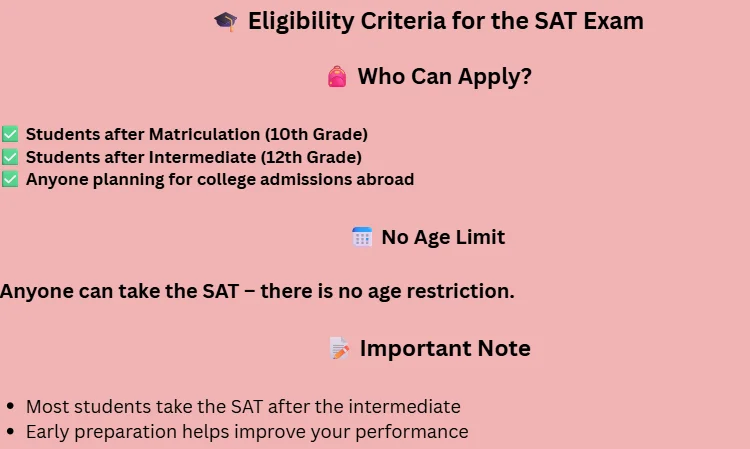
Eligibility Criteria for the SAT Exam
For the SAT score, there is no age limit. However, the students usually take this test after intermediate exams. You can also take the SAT exam after matriculation. Every student from a student eligible for this test who has completed the matriculation and intermediate. You can also attempt the SAT exam every year if you are unsuccessful in one year; there is no limit.
How to Register for the SAT?
- Go to the College Board website and create an account.
- After account creation, select your test date and location.
- Choose a test center near you.
- Fill in personal and school details.
- Upload your photo as per the guidelines.
- Pay the registration fee using PayPal with a Credit Card.
- Complete the registration and print the admission ticket.
Who Qualifies for SAT Fee Waivers?
The College Board provides SAT fee waivers to eligible students, making the college admissions test accessible regardless of financial background. Here is how to qualify: students enrolled in the federal free or reduced-price lunch program, those receiving public assistance, students living in federally subsidized housing, and students in foster care are typically eligible. Fee-waiver recipients can take two free SAT administrations and send unlimited free score reports to colleges a significant financial benefit during the application process.
To apply for a waiver, work directly with your school counselor, who submits the request on your behalf. You cannot apply for a fee waiver independently through the College Board website. Waivers also cover the $34 late registration surcharge, so fee-eligible students should still aim to register by the standard deadline to avoid any complications. Approximately 68% of SAT test-takers in 2025 completed the exam during school-day SAT administrations, which are often free of charge and handled by the school.
SAT by the Numbers: Key Statistics for 2026
📊 2026 SAT Fast Facts
- 2+ million students from the Class of 2025 took the SAT at least once.
- 97% of test-takers used the fully digital format the first predominantly digital year in U.S. testing history.
- 68% completed the SAT during school-day administrations, improving equitable access nationwide.
- The average SAT score for the Class of 2025 was approximately 1029.
- The SAT is accepted by over 4,000 colleges in the U.S. and by universities in more than 85 countries worldwide.
- The registration fee for the SAT in 2026 is $68, with a $34 late fee surcharge.