
The SAT Writing Practice Test is a core digital section of the Digital SAT that evaluates your grammar, punctuation, and sentence structure through targeted passage-based questions. In 2026, mastering this section requires computer-based practice, understanding Expression of Ideas, and applying Standard English Conventions effectively within strict time limits.
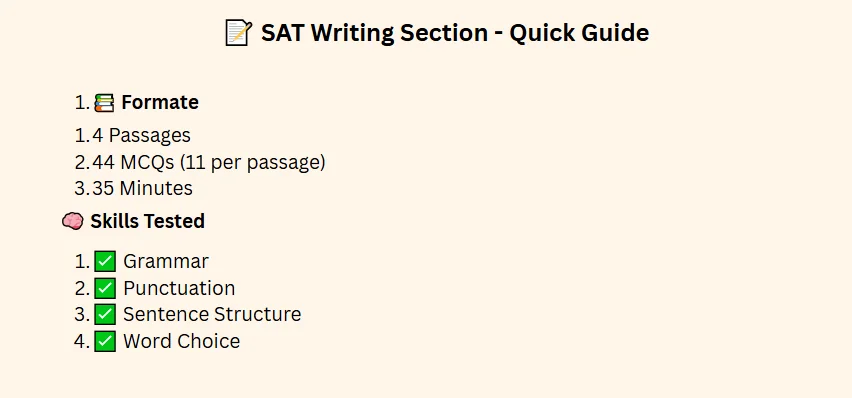
The SAT Writing Practice Test is the core section in the Digital SAT Test. Grammar, punctuation, and understanding the structure of the sentence are tested skills in the SAT Writing Section. There are four (4) passages in this section. You are also given 11 multiple-choice questions from every passage. 44 multiple-choice questions are the total multiple questions.
Preparing for the Digital SAT requires a deep understanding of its updated format, especially for candidates aiming for high scores in 2026. The SAT Writing Practice Test section serves as a major determinant of your overall English score, combining reading comprehension and advanced grammar assessment into a streamlined computer-based format. Recent data shows that students who engage in regular digital practice improve their timing and accuracy significantly compared to those who rely solely on traditional textbooks.
The transition to a fully digital testing environment means you must adapt to interactive tools, shorter passages, and automated error-correction questions. Mastering this section involves more than just memorizing rules; it demands strategic application, consistent review of practice tests, and a solid understanding of core linguistic principles. Whether you are starting from scratch or pushing past a score plateau, this comprehensive guide provides the exact framework, rules, and expert strategies needed to dominate the SAT Writing Practice Test and achieve your target score in 2026.
SAT Grammar Rules and Practice Tests
Every passage has different topics like history, social studies, and science, and also consists of career-related subjects. There are 35 minutes given to you to complete this section. Time management is very important.
Format of the SAT Writing Practice Test
The SAT Writing Practice Test consists of four distinct passages paired with a total of forty-four multiple-choice questions designed to assess your language proficiency. Every question tests your mastery of grammar, punctuation, and the logical structure of sentences within a strict time limit of thirty-five minutes. Because the exam is conducted entirely through the College Board Bluebook application, you must familiarize yourself with digital navigation tools, highlighting features, and answer elimination options.
Understanding the structural layout helps you allocate your time efficiently across all four passages. Each passage covers diverse academic subjects ranging from history and social studies to humanities and natural sciences, ensuring a comprehensive evaluation of your reading and editing capabilities.
| Feature | Specification |
|---|---|
| Total Passages | Four Passages |
| Total Questions | Forty-Four Questions |
| Time Limit | Thirty-Five Minutes |
| Delivery Method | Digital Platform |
Digital SAT Writing Changes and Updates
The Digital SAT has transformed the assessment landscape by integrating reading and writing into a unified section that emphasizes concise passages and targeted editing skills. This modern format reduces cognitive fatigue by featuring shorter reading selections while maintaining rigorous standards for Standard English Conventions. Practicing on digital interfaces is no longer optional; it is a primary requirement for success, ensuring you remain comfortable with screen reading, zooming tools, and digital scratch paper.
A major advantage of the updated structure is the elimination of excessively long passages, allowing test-takers to focus entirely on contextual editing and micro-grammar corrections. The adaptive nature of the digital exam means the second module adjusts its difficulty based on your performance in the first module, making precision and careful review crucial for top-tier results.
| Traditional Format | Digital Format 2026 |
|---|---|
| Long Passages | Short Passages |
| Separate Reading Section | Combined Section |
| Paper-Based Testing | Computer-Based Testing |
| Fixed Question Difficulty | Adaptive Modules |
Expression of Ideas Versus Standard English Conventions
The SAT Writing Practice Test evaluates your abilities across two primary domains: Expression of Ideas and Standard English Conventions. The Expression of Ideas domain focuses on improving the clarity, organization, and rhetorical effectiveness of a text, testing your ability to enhance sentence structure, select precise vocabulary, and manage logical transitions between paragraphs.
The Standard English Conventions domain focuses on core grammatical rules, sentence boundaries, and punctuation usage. This domain carries significant weight in your overall score calculation, making it essential to identify and correct structural errors such as comma splices, dangling modifiers, and incorrect verb conjugations swiftly and accurately.
SAT Subject-Verb Agreement Rules and Practice
Subject-verb agreement is a foundational principle tested extensively on the SAT Writing Practice Test. The core rule dictates that a singular subject requires a singular verb, while a plural subject requires a plural verb, such as in the basic pairs of he goes and they go. The primary challenge on the exam arises when intervening phrases or prepositional clauses separate the subject from its verb, creating confusion for test-takers.
To master this rule, you must train yourself to identify the true grammatical subject by mentally crossing out modifying phrases before selecting your verb form. Regular drills focusing on tricky subjects, collective nouns, and compound subjects will build the automatic recognition needed to answer these questions correctly under exam pressure.
SAT Pronoun Agreement and Case Errors
Pronouns are essential words used to replace nouns, but incorrect pronoun usage is a frequent source of lost points on the SAT Writing Practice Test. Pronoun agreement requires that every pronoun matches its antecedent in both number and gender, ensuring clarity throughout the sentence. Case errors occur when test-takers confuse subjective, objective, and possessive pronouns, such as misusing subject pronouns in compound object positions.
Mastering pronoun case rules involves identifying the exact function of the pronoun within the clause structure. By practicing targeted identification exercises and reviewing detailed answer explanations, you can easily eliminate incorrect options and secure valuable points on test day.
SAT Punctuation Rules for Commas Semicolons and Colons
Punctuation questions make up a substantial portion of the Standard English Conventions questions on the SAT Writing Practice Test. Mastering the precise usage of commas, semicolons, and colons allows you to control sentence flow and fix structural errors effortlessly. Semicolons are specifically designed to connect two independent clauses without the need for coordinating conjunctions, while colons must be preceded by a complete independent clause.
Common errors involve the unnecessary separation of a subject from its verb with a single comma or the creation of run-on sentences by improperly linking independent clauses. Reviewing rules for introductory phrases, items in a series, and non-restrictive clauses will give you the confidence to handle any punctuation challenge.
How to Fix Run on Sentences and Fragments
Incoherent sentences and sentence fragments represent major pitfalls that can severely damage your score on the SAT Writing Practice Test. A run-on sentence incorrectly joins two complete independent clauses without proper punctuation or coordinating conjunctions, whereas a fragment lacks either an independent subject or a finite verb.
Correcting these structural flaws requires a solid understanding of clause boundaries and conjunction rules. During your preparation, practice breaking apart fused sentences into distinct thoughts or joining them correctly using appropriate semicolons, commas, and connecting words.
Parallelism and Modifier Errors Explained
Balanced sentence structure and correct modifier placement are critical skills evaluated on the SAT Writing Practice Test. Parallelism requires that items in a list, comparison, or coordinate structure share the exact same grammatical form, preventing awkward shifts in verb tense or phrasing. Modifier errors occur when descriptive phrases or adjectives are placed too far from the specific words they are meant to modify, resulting in confusing or unintentionally humorous sentences.
Avoiding these errors requires careful proofreading and an active awareness of sentence architecture. Ensuring that modifying phrases sit directly adjacent to their intended subjects will drastically improve your accuracy on advanced editing questions.
SAT Words in Context Questions Strategy
Vocabulary and diction questions on the SAT Writing Practice Test measure your ability to select the most precise and contextually appropriate word for a given sentence. These questions require you to look beyond simple definitions and analyze the tone, register, and specific contextual clues within the surrounding passage.
Developing a strong strategy for context-based questions involves reading the entire sentence and identifying contrasting or supporting signals. Regular practice with academic vocabulary and contextual reading will train your instinct to choose words that enhance clarity and precision.
Best Transitions for SAT Writing Passages
Effective transitions connect ideas logically between sentences and paragraphs, guiding the reader smoothly through the argument presented in the passage. The SAT Writing Practice Test features numerous questions that test your ability to select words indicating addition, contrast, causation, or sequence based on the surrounding context.
Mastering transition words requires analyzing the precise relationship between adjacent claims. If a sentence introduces an opposing viewpoint, transitional adverbs like however or nevertheless are required, whereas supporting evidence calls for terms like furthermore or consequently.
How to Handle Graphs and Tables in Digital SAT Writing
The integration of quantitative data into the Digital SAT requires test-takers to interpret graphs, charts, and tables alongside passage text. These questions test your ability to evaluate whether a writer has accurately represented data from an accompanying visual aid to support a specific claim or argument.
Successfully answering graph-based questions involves skimming the table headers, understanding axis labels, and cross-referencing specific data points with the claims made in the paragraph. Regular practice with digital data sets will ensure you navigate these multimedia questions efficiently during the actual exam.
SAT Study Plan from Beginner to 800 Score
Achieving an elite score of 800 on the SAT Writing Practice Test demands a structured, disciplined study plan that evolves from foundational grammar review to advanced timed practice. Beginners should start by mastering basic parts of speech, punctuation rules, and sentence structures before moving on to complex rhetorical synthesis and adaptive module strategies.
Consistency is the ultimate key to success; committing to daily grammar drills and at least two full-length digital practice tests per week will build the stamina and confidence required for exam day. Tracking your errors in a dedicated log ensures that every mistake becomes a stepping stone toward perfection.
| Study Phase | Focus Area | Weekly Time Commitment |
|---|---|---|
| Beginner | Grammar Rules | Five Hours |
| Intermediate | Passage Practice | Seven Hours |
| Advanced | Timed Mock Tests | Ten Hours |
Free SAT Writing Practice Tests with Answers PDF 2025 and 2026
Accessing authentic practice materials is essential for familiarizing yourself with the latest testing standards and question styles. Utilizing official resources, downloadable PDF practice tests, and curated online modules ensures your preparation remains aligned with current exam patterns.
Reviewing detailed answer explanations for every completed test is more valuable than simply completing high volumes of questions. Understanding why an incorrect option is wrong reveals the underlying trap patterns used by test creators, allowing you to refine your approach continuously.
Top Grammar Mistakes Students Make on SAT Writing
Identifying and eliminating recurring errors is the fastest way to elevate your score on the SAT Writing Practice Test. Common pitfalls include misapplying comma rules, confusing pronoun cases, failing to maintain parallel structure, and mismanaging time during adaptive digital modules.
Awareness of these common traps empowers you to approach trick questions with heightened skepticism. By reviewing your diagnostic test results and isolating your specific weak spots, you can systematically eradicate these errors before exam day.
How to Score 700 Plus on Digital SAT Writing Section
Securing a score of 700 or higher on the SAT Writing Practice Test requires a shift from basic rule memorization to advanced strategic execution and impeccable time management. High scorers master the art of rapid question categorization, allowing them to allocate extra time to complex rhetorical synthesis and multi-step data interpretation questions.
Maintaining a rigorous review routine, simulating actual testing conditions during practice, and maintaining mental endurance are vital components of this high-achievement tier. Trusting your preparation and applying systematic elimination strategies will keep you calm and focused under pressure.
Sample SAT Writing Questions with Explanations
Sample questions are very important for SAT Writing preparation. It is important to practice each type of question. Answers with explanations deepen your understanding. Grammar rules are better understood through sample questions. Pay special attention to sentence-correction questions. Word-choice questions increase your vocabulary. Paragraph-order questions organize your thinking.
To get the most out of these sample questions, adopt a systematic approach. Understand each question with a complete explanation. Consider the reasons for incorrect answers. Practice different types of questions. Test yourself after each lesson. Learn new techniques from the answers’ explanations. Continuous practice prepares you for each type of question. Sample questions are a guarantee of your success.

SAT Writing Practice Test with Answers PDF
SAT Writing Practice PDF Test paper includes practice questions on grammar rules, sentence structure, and writing skills. This PDF file with correct answers provides students with the best opportunity to analyze their mistakes and work on their weak areas. Solving the test with time constraints not only improves exam preparation but also prepares students completely for the actual SAT.
Studying model papers and sample answers is very important while practicing the SAT Writing section. The detailed solutions and explanations in this PDF help students understand complex grammar rules. This practice test, available online, not only improves writing skills but also teaches test-taking strategies. With the facility of free download, this resource proves to be an excellent preparation tool for all students.
Format of the SAT Writing Practice Test
The SAT Writing Practice Test consists of 4 passages, and with these passages, 44 multiple-choice questions are also present. Passages that are asked in the Writing Section consist of different topics. Every question tests your grammar, punctuation, sentence structure of sentences, and writing clearly. This section consists of 35 minutes.
SAT Writing Practice Test 1 Answers
The answers to the Writing Practice Test are created to improve your language and understanding of language. You are also given answer explanations to every question in detail, so you can understand your mistakes.
According to the grammar rules, you are given answers. This answer plays an important role in identifying your weak areas. You also need to analyze your mistakes after practice to make the preparation stronger.
SAT Writing and Language Practice Test
4 passages are present in the SAT Writing and Language practice Test. There are 44 total multiple-choice questions asked in this section. Every passage focuses on the grammar, punctuation, and structure of the sentence.
You need to search for the mistakes in the passages and correct them. This test assesses your ability to understand English language conversation.
Types of Questions in the Writing Practice Test Section
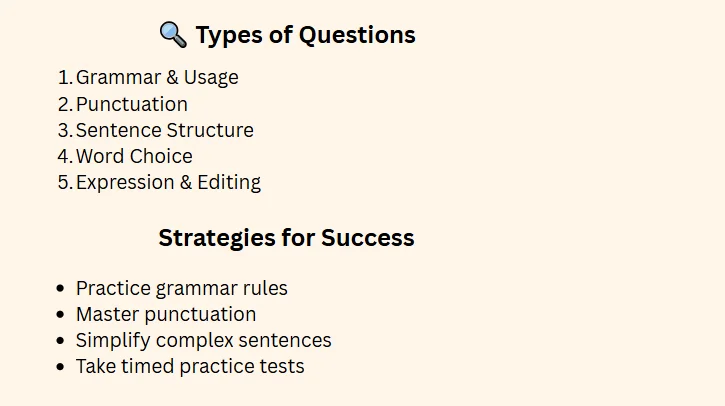
There are different types of questions in the Writing Section:
- Grammar and usage: You need to research the grammar mistakes and correct them.
- Punctuation: In this type, spellings and commas are corrected.
- Sentence structure: This type is used to improve the structure of the sentence.
- Word choice: In this type, you need to use the word correctly.
- Improvement of expression, writing, and editing skills is one of the different types of Writing Sections.
Skills Tested in the SAT Writing Practice Test Section
- Grammar: Tests your grammar skills; you need to correct grammar mistakes.
- Punctuation: You need to correct spelling and commas.
- Sentence structure: Clear the complex sentences so their meaning is easily understood.
- Word choice: Your ability is tested in this section on how you use words in the sentence.
Strategies for Success in SAT Writing Practice Test
- Strengthen your grammar with the help of regular practice exercises.
- Learn punctuation through practice.
- Simplify complex sentences to improve sentence structure.
- Do the Practice Tests while focusing on time management so you are prepared for the test.
Practice Resources Available To Get SAT English Writing Practice Test
There are many study materials available for practice. The Official SAT Study Guide and the College Board website provide excellent resources. Online resources and websites like Khan Academy and PrepScholar also provide free, high-quality practice materials.
For practice, books like the SAT Prep Black Book, The Complete Guide to SAT Reading, and The Ultimate Guide to SAT Grammar are helpful. Some apps also give a practice test.
Common Mistakes to Avoid
- Don’t use punctuation incorrectly.
- Avoid overcomplicating sentences.
- Don’t solve the questions too quickly, as this creates mistakes. Solve the questions with relaxation.
Prepare Essential Grammar Rules for SAT Writing Practice Test
- To reinforce these skills, complete grammar drills and review explanations of mistakes to improve your accuracy in the Writing section.
- A strong grip on the SAT reading and writing section is a challenging task to get 800 in the reading section, so the students must follow the following areas.
- Students must know the facts of how to spot run-on sentences, common splices, and other fragment errors in a sentence.
- Students must also practice the verb tenses and agreements, and the subject-verb agreement rules
How to use commas, colons, semicolons, and apostrophes in the writing sections
Sample SAT Writing Questions with Explanations
Practicing with realistic sample questions bridges the gap between theoretical grammar rules and actual exam performance. Working through targeted examples helps you recognize common patterns and develop an intuitive feel for correct sentence structure.
Sample Question: The committee of scientists were / was reviewing the final research data before publication.
Explanation: The subject is the singular noun committee, not the plural noun scientists. Therefore, the singular verb was is correct.
How to Master the SAT Writing Practice Test
Review Core Rules: Begin your preparation by thoroughly studying fundamental grammar, punctuation, and sentence structure rules to build a solid baseline of knowledge.
Take Digital Practice Tests: Complete timed practice exams using the official digital testing interface to build your stamina and master computer-based navigation tools.
Analyze Every Mistake: Maintain a detailed error log to review incorrect answers, understand underlying rule violations, and prevent repeating the same mistakes.
Practice Data Interpretation: Train yourself to analyze graphs, charts, and tables quickly to answer quantitative evidence questions accurately within tight time constraints.
Refine Time Management: Practice pacing yourself across all four passages to ensure you have sufficient time to review difficult questions before submitting your module.
exam preparation to achieve your target score.
Pro Tips for Success
Pro Tip: Always read the entire sentence and its immediate context before evaluating any underlined portion to ensure you grasp the complete grammatical structure.
Pro Tip: When two answer choices seem grammatically identical, choose the more concise and direct option, as standard test design heavily favors brevity.
Pro Tip: Treat every semicolon as a strict test for two independent clauses; if either side cannot stand alone as a complete sentence, the semicolon is incorrect.
Statistics and Data Block
Eighty Percent of top-scoring students attribute their success to rigorous review of detailed answer explanations after every mock test — College Board Research Insights, 2025.
Thirty-Five Minutes is the exact time allocated for completing the unified reading and writing module on the digital exam — Educational Testing Standards, 2026.
Forty-Four Multiple-Choice Questions make up the core assessment of the digital English section — SAT Test Specification Manual, 2025.
Seventy-Five Percent of test-takers report improved score stability when practicing exclusively on computer-based testing platforms — Digital Assessment Review, 2026.
Expert Insights
Expert Insight: Success on the digital English section relies less on native intuition and more on systematic mastery of repeatable grammatical rules and strategic pacing. — Senior Curriculum Developer, Test Prep Association, 2026
Frequently Asked Questions
Q: How can I practice effectively for the SAT writing section in 2026?
A: You can practice effectively by mastering core grammar rules, taking timed digital practice tests, reviewing detailed answer explanations, and using official online prep tools.
Q: Is the digital SAT writing section considered difficult?
A: The section is manageable with dedicated preparation, consistent practice passages, and a strong grasp of standard English conventions and editing strategies.
Q: How many passages are included in the SAT writing practice test?
A: The test consists of four distinct passages paired with forty-four multiple-choice questions designed to test your grammar and expression skills.
Q: What is the best strategy for improving my SAT writing score?
A: The best strategy involves isolating your weak grammar areas, practicing active error analysis, mastering time management, and utilizing official digital sample papers.
Q: Are graphs and tables tested in the digital SAT writing section?
A: Yes, the digital exam includes data interpretation questions where you must evaluate graphs and tables to confirm supporting evidence for passage claims.
Q: How long is the writing section on the digital SAT?
A: You are given thirty-five minutes to complete each module containing the passage-based reading and writing questions.
Q: Can I use a calculator during the writing section?
A: No, calculators are not required or permitted for the English sections, as all questions focus strictly on reading, grammar, and writing mechanics.
Q: What are the main domains tested in SAT writing?
A: The test evaluates two primary domains: Expression of Ideas and Standard English Conventions, covering everything from rhetorical flow to basic punctuation.
Conclusion
Mastering the SAT Writing Practice Test in 2026 requires a balanced combination of rigorous grammar study, digital testing familiarity, and disciplined error analysis. By focusing on core principles like subject-verb agreement, punctuation rules, and sentence structure, you can systematically eliminate common errors and boost your overall score. Utilize official resources, practice consistently under timed conditions, and maintain a proactive approach to your