
The Digital SAT Math Geometry Test covers geometry and trigonometry questions that make up approximately 15% of the full SAT Math section, totaling 5 to 7 questions across two adaptive modules. Topics include lines and angles, triangles, circles, coordinate geometry, area, volume, and right triangle trigonometry. Students practice best using the Bluebook app with a built-in Desmos graphing calculator, which is available for every question on the Digital SAT Math section.
Key Takeaways
- Geometry and Trigonometry accounts for roughly 10 to 15% of SAT Math, or 4 to 6 questions out of 44 total Catalysttestprep
- The Digital SAT Math section has 44 questions across two 35-minute modules, for a total of 70 minutes
- Approximately 75% of Math questions are multiple choice and 25% are Student-Produced Response (SPR) where students type in their own answer
- A built-in Desmos graphing calculator is available for every Math question no external calculator is needed
- The Digital SAT Math format for 2026 is unchanged from the 2024 structure all 2024 and 2025 practice materials remain fully valid IvyMax
- No penalty for wrong answers attempt every geometry question even under time pressure
- The SAT is scored on a 400 to 1600 scale; the Math section is scored 200 to 800
SAT Geometry Test for Practice is a very useful and authentic source to practice the SAT exam. sat practice test prep provides so many practice tests of the Math and Geometry sections for the SAT. This will give the proper structure, environment, and question pattern that comes in the actual SAT Geometry section are very important part of this section.
Need the best practice for the Digital SAT Math Geometry test? Then you are at the right place! Here we are providing you with a complete list of high-quality practice questions, online tests, free practice papers, and geometry formulas for the Geometry and Coordinate Geometry sections of the Digital SAT Math.
The new format of the Digital SAT 2025-2026 includes important LSI topics like Trigonometry, Circle, Triangle, Coordinate Plane, Area, Perimeter, Volume, and Lines and Angles. With our SEO optimized and AI-generated practice tests, you will be one step closer to achieving a high score. Start Digital SAT Geometry practice now and get an experience like the real College Board exam!
What Is the Digital SAT Math Geometry Test?
SAT Geometry Test for Practice is a very useful and authentic source to practice the SAT exam. SAT practice test prep provides so many practice tests of the Math and Geometry sections for the SAT. This will give the proper structure, environment, and question pattern that comes in the actual SAT Geometry section, which is a very important part of this section.
Need the best practice for the Digital SAT Math Geometry test? Then you are at the right place! Here we are providing you with a complete list of high-quality practice questions, online tests, free practice papers, and geometry formulas for the Geometry and Coordinate Geometry sections of the Digital SAT Math.
The new format of the Digital SAT 2025–2026 includes important topics like Trigonometry, Circle, Triangle, Coordinate Plane, Area, Perimeter, Volume, and Lines and Angles. With our practice tests, you will be one step closer to achieving a high score. Start Digital SAT Geometry practice now and get an experience like the real College Board exam!
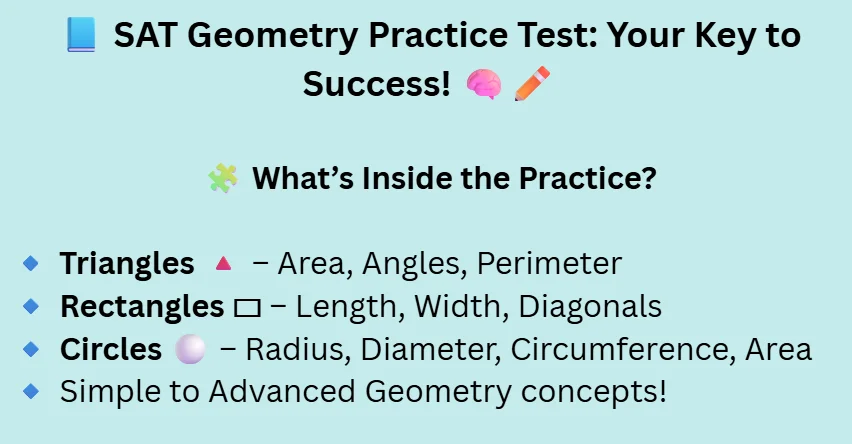
The SAT Geometry practice test includes the topics relevant to triangles, rectangles, and circles. Students are required to solve the simple parameters, areas, diameter, and circumference-related questions. These questions come from the basic concepts of geometry.
SAT Geometry Test Structure and Weightage 2025–2026
How Many Geometry Questions Are on the Digital SAT in 2026?
Geometry and Trigonometry questions account for 15% of all SAT Math questions, appearing as approximately 5 to 7 questions across the two adaptive Math modules. Understanding how this fits into the full test structure helps students allocate study time efficiently. UWorld
| SAT Math Domain | Percentage of Math Section |
|---|---|
| Algebra | 40 to 45% (approximately 18 to 20 questions) |
| Advanced Math | 25 to 30% (approximately 11 to 13 questions) |
| Problem Solving and Data Analysis | 15% (approximately 5 to 7 questions) |
| Geometry and Trigonometry | 15% (approximately 5 to 7 questions) |
Algebra and data analysis together make up nearly 70% of SAT Math questions, so students who prioritize these areas first often see faster score improvements than those who spread effort evenly across all topics. That said, geometry questions are predictable, formula-driven, and highly learnable making them one of the fastest areas to improve with focused practice. Catalysttestprep
The Digital SAT uses a multistage adaptive system, adjusting question difficulty based on student performance. Your Module 1 score determines whether Module 2 contains easier or harder questions, which directly determines your score ceiling. A student who answers geometry questions correctly in Module 1 is more likely to unlock harder and higher-scoring geometry questions in Module 2.
Pro Tip: Since geometry accounts for 5 to 7 questions and each question carries significant weight in the adaptive scoring model, getting all geometry questions correct can meaningfully raise your total Math score, especially if these questions appear in Module 2 where they carry higher scoring weight.
SAT Math Heart of Algebra Practice Test
The SAT Geometry practice test includes the topics relevant to triangles, rectangles, and circles. Students are required to solve the simple parameters, areas, diameter, and circumference-related questions. These questions come from the basic concepts of geometry.
SAT Geometry Topics
Geometry consists of different topics in the math section. Dimensional measurement, this topic is essential to the length and width of the subject. In this topic, you need to understand the angles of triangles, squares, and other shapes. Principle of the triangle. This topic consists of the different triangles and the relationship of their angles.
In this topic, you need to measure and understand the parameter, area, and diameter of the circle. Coordinate system. This topic consists of making the shapes on the graphs and understanding their qualities. The movement of shapes means rotating the shape from one place to another. 3D Shapes: These shapes are those that expand in different directions, such as cubes, cones, and spheres.
What Are All the Topics Covered in the Digital SAT Geometry and Trigonometry Section?
The Geometry and Trigonometry category mainly focuses on information covered in Geometry courses, with elements of trigonometry typically taught in Pre-Calculus. The two main trigonometric concepts students must know are the right triangle trigonometric functions sine, cosine, and tangent and how to convert radians to degrees in a circle.
| Geometry Topic | What It Tests |
|---|---|
| Lines and Angles | Supplementary angles, vertical angles, parallel lines cut by a transversal |
| Triangles | Pythagorean theorem, similar triangles, special right triangles (30-60-90, 45-45-90) |
| Circles | Area, circumference, arc length, sector area, central angle, tangent lines |
| Coordinate Geometry | Slope, midpoint, distance formula, equation of a line, graph interpretation |
| Polygons and Quadrilaterals | Area and perimeter of squares, rectangles, parallelograms, trapezoids |
| Area and Volume | Surface area, volume of cylinders, cones, spheres, rectangular prisms |
| Right Triangle Trigonometry | Sine, cosine, tangent, complementary angle relationships |
| Radians and Degrees | Converting between radian and degree measure within circle problems |
SAT trig problems are limited to right triangles students will not see the unit circle or trig identities beyond the Pythagorean identity on the Digital SAT. This makes trigonometry far more manageable than most students initially fear
What Question Formats Appear in SAT Geometry?
SAT Math includes approximately 75% multiple choice questions with four answer options, and 25% Student-Produced Response (SPR) questions where students type in a numerical answer directly into a text box without any answer choices shown. Geometry questions appear in both formats.
In multiple choice geometry questions, students must identify the correct value from four options. The wrong answer choices are often the results of common errors for example, using diameter instead of radius in a circle formula, or forgetting to square the radius before multiplying by π. In SPR geometry questions, no answer choices are shown, which means elimination strategies do not help. Students must set up and solve the problem correctly from start to finish. For SPR questions, always double-check whether the answer should be in decimal, fraction, or whole number form before entering it.
Pro Tip: On grid-in geometry questions involving π, the Bluebook platform accepts answers both as decimals (e.g., 12.566) and as expressions with π (e.g., 4π). When in doubt, leave the answer in terms of π to avoid rounding errors that could cost you the point.
SAT Geometry Questions
The structure of the SAT Geometry Questions is according to angles, structure, and measurement. Students have to know how to solve circle, square, and three-dimensional shape problems. This section is a collection of the calculated perimeter, area, volume, and angles topics. If you understand the formulas and rules, you can easily solve this problem without any difficulty.
SAT Geometry Formulas
Some formulas are very important in the Geometry section of the SAT. Learning this formula is very important for solving the questions.
- Square Area: side = side × side
- Square Perimeter: 4 × side
- Rectangle Area: length × width
- Rectangle Perimeter: 2 × (length + width)
- Triangle Area: 1/2 × base × height
- Circle Area: π × r²
- Circle Circumference: 2 × π × r
- Cube Volume: Side³
- Sphere Volume: (4/3) × π × r³
- Cone Volume: (4/3) × π × r³
Pro Tip: Do not waste time during the test opening the reference sheet for basic formulas like circle area or triangle area. Memorize the 10 most commonly tested geometry formulas before test day so you can work without interruption. Save the reference sheet for the rare question involving a 3D volume formula you may have forgotten.
Digital SAT Geometry Questions and Answers Worksheet
A complete worksheet is very helpful for preparing for Digital SAT Geometry questions. It covers all the important geometry topics like lines, angles, triangles, circles, and polygons. This worksheet helps you understand the step-by-step solutions to each problem. According to the Digital SAT Blueprint, this worksheet enhances your knowledge. Students can download and print it and practice solving it on paper. Checking the correct answers after practicing helps you to correct your mistakes.
A good worksheet should have a set of questions from easy to difficult. This allows you to gradually increase your skills. The explanatory answers at the end of each section improve your understanding. Using a worksheet to prepare for geometry is a proven strategy. It helps you to automatically identify your weaknesses. This is what math teachers often advise students to do. Free downloadable worksheets are easily available on the internet.
Where Can Students Find the Best Free Digital SAT Geometry Practice Resources?
The answer is to start with official College Board resources before moving to third-party platforms. The College Board has expanded the number of full-length practice tests available in the Bluebook app, making it the single most accurate simulation of actual test-day conditions. IvyMax
The Bluebook platform displays a countdown clock throughout each module and allows students to flag questions and return to them within a module, but not between modules exactly how the real test works. Practicing with this exact interface removes test-day interface confusion and saves real time.
How to Use the Desmos Calculator for SAT Geometry Questions
Does the Digital SAT Allow a Calculator for Geometry Questions?
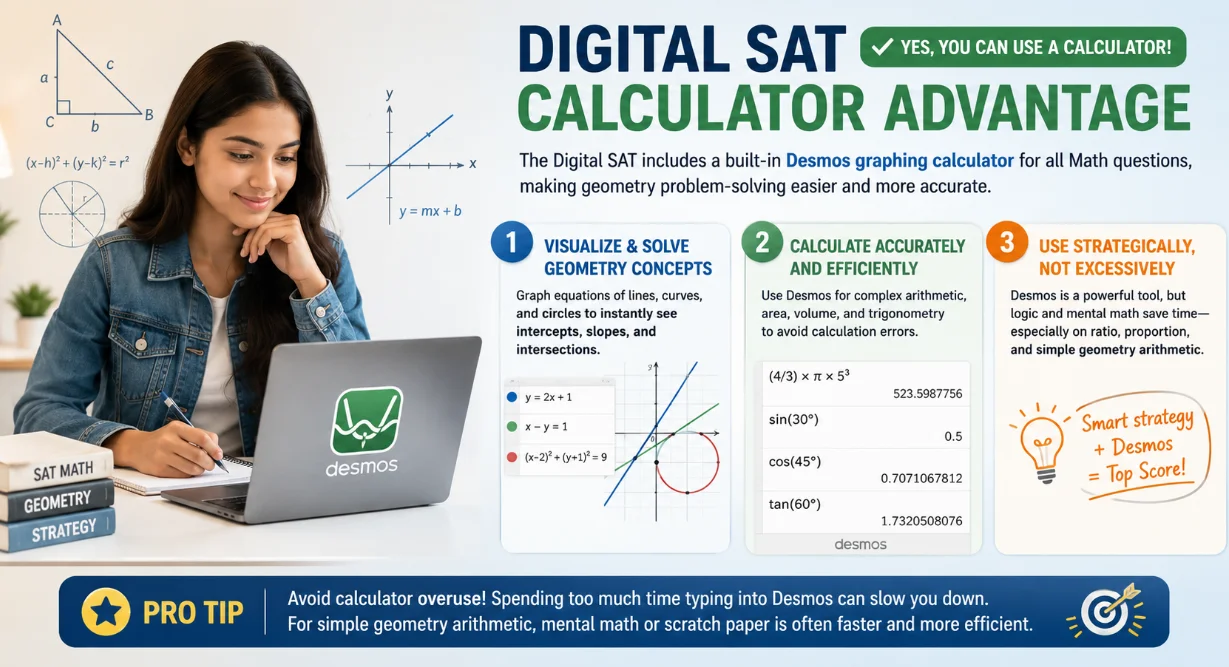
Yes and this is one of the most important advantages of the Digital SAT format. A built-in Desmos graphing calculator is available for all Math questions on the Digital SAT, eliminating the previous no-calculator restriction that existed on the paper SAT.
Here is how to use Desmos effectively on geometry questions:
Step 1 — For coordinate geometry questions: Type the equation of a line or curve directly into Desmos to see it graphed instantly. This lets you visually identify slope, intercepts, and intersections without manual calculation.
Step 2 — For circle equations: Type the standard form of a circle equation (x-h)² + (y-k)² = r² into Desmos to instantly see the circle plotted on the coordinate plane.
Step 3 — For area and volume questions: Use Desmos as an arithmetic calculator to evaluate expressions like (4/3) × π × 5³ without calculation errors.
Step 4 — For triangle and angle problems: Desmos cannot draw geometric figures from angle descriptions, so use it for calculations only not for diagramming triangle problems.
Step 5 — For trigonometry: Type sin(30°), cos(45°), or tan(60°) directly into Desmos to get exact decimal values for angle calculations.
Pro Tip: One of the most common SAT Math mistakes is calculator overuse spending time typing into Desmos instead of applying logic, especially on ratio or proportion questions. For simple geometry arithmetic, working mentally or on scratch paper is often faster than opening the calculator.
How to Use the Desmos Calculator for SAT Geometry Questions
Does the Digital SAT Allow a Calculator for Geometry Questions?
Yes and this is one of the most important advantages of the Digital SAT format. A built-in Desmos graphing calculator is available for all Math questions on the Digital SAT, eliminating the previous no-calculator restriction that existed on the paper SAT.
Here is how to use Desmos effectively on geometry questions:
Step 1 — For coordinate geometry questions: Type the equation of a line or curve directly into Desmos to see it graphed instantly. This lets you visually identify slope, intercepts, and intersections without manual calculation.
Step 2 — For circle equations: Type the standard form of a circle equation (x-h)² + (y-k)² = r² into Desmos to instantly see the circle plotted on the coordinate plane.
Step 3 — For area and volume questions: Use Desmos as an arithmetic calculator to evaluate expressions like (4/3) × π × 5³ without calculation errors.
Step 4 — For triangle and angle problems: Desmos cannot draw geometric figures from angle descriptions, so use it for calculations only not for diagramming triangle problems.
Step 5 — For trigonometry: Type sin(30°), cos(45°), or tan(60°) directly into Desmos to get exact decimal values for angle calculations.
Pro Tip: One of the most common SAT Math mistakes is calculator overuse spending time typing into Desmos instead of applying logic, especially on ratio or proportion questions. For simple geometry arithmetic, working mentally or on scratch paper is often faster than opening the calculator.
Free Digital SAT Geometry Practice Tests Online
Free online digital SAT geometry practice tests are a great gift for students. These tests provide you with an environment similar to the real digital SAT. Questions covering all the principles of geometry, such as ratio, area, and product, complete your preparation. By solving these online tests, you can work on both your speed and accuracy. Automatic scoring after each practice test gives you instant feedback.
The advantage of these free resources is that you can test your performance at home. These tests often come with complete solutions, which keep the learning process going. Getting into the habit of solving geometry problems on a digital platform is very beneficial on test day. This practice increases your confidence and reduces test stress. Taking the test under time constraints improves your time management skills.
SAT Lines, Angles, and Triangles Geometry Practice Test
The SAT Geometry section often includes questions about lines, angles, and triangles. Parallel lines, right angles, and triangle rules are its main topics. It is important to have a grasp of triangle rules, such as the Pythagorean theorem and the different types of triangles. Understanding the relationship between angle measurements and lines is key to solving these questions. A good practice test covers all of these aspects.
While solving the practice test, focus on the triangle area formula and special problems for scalene triangles. With practice, you will learn to quickly recognize angle problems. Knowing the interior and exterior angles of a triangle will help you solve complex questions easily. Consistent practice on all types of triangles will make you an expert. This section plays a significant role in your overall SAT score.
SAT Circles Geometry Practice Test
The SAT Circles Geometry Practice Test introduces you to all the concepts related to circles. The area of a circle, the perimeter of a circle, and the diameter formulas are its basic parts. Pay special attention to problems that involve the arc, sector, and central angle of a circle. Understanding the principles of circle geometry is beneficial for students. The practice test also teaches methods for solving circle problems quickly.
Circle problems often require knowledge of theorems such as the tangent theorem. Remember the correct names of the different parts of a circle and their relationships during practice. Practicing the circle theorem will enable you to solve complex questions easily. Try to solve all kinds of circle problems so that you can face any difficulty. This practice will increase your geometry score.
What Circle Formulas Are Most Important for the Digital SAT?
The answer is that arc length and sector area formulas are the most frequently missed circle concepts because they are not always intuitive yet they appear regularly on the Digital SAT.
| Circle Concept | Formula |
|---|---|
| Area of a circle | πr² |
| Circumference | 2πr |
| Arc length | (central angle / 360) × 2πr |
| Sector area | (central angle / 360) × πr² |
| Diameter to radius conversion | r = d / 2 |
| Equation of a circle on coordinate plane | (x - h)² + (y - k)² = r² |
A tangent line to a circle always meets the radius at exactly 90 degrees at the point of tangency. This relationship creates a right triangle that the SAT frequently uses to connect circle geometry with the Pythagorean theorem in a single question.
SAT Polygons and Quadrilaterals Geometry Practice Test
The SAT Polygons and Quadrilaterals Geometry Practice Test covers several important shapes. These include squares, rectangles, parallelograms, and rhombuses. It is important to learn the specific rules and formulas for each shape. Get to grips with the sum of the interior angles of a quadrilateral and the properties of its diagonals. Knowledge of isosceles shapes is very useful in polygon problems.
Memorize the formulas for the area and perimeter of these shapes well. The practice test teaches you to differentiate between different quadrilaterals. Students should be able to recognize problems based on shape and use the correct formulas. Consistent practice will help you understand the secrets of these shapes. Working on all types of polygons will complete your preparation. This section can successfully raise your SAT math score.
SAT Area and Volume Geometry Practice Test
In the SAT Area and Volume Practice Test of geometry, you have to understand basic concepts such as area, volume, length, width, height, depth, surface area, edge, straight line, angle, circle, square, rectangle, triangle, sphere, and solid shape only. Area and volume questions in the SAT are asked to see how well you understand the principles of shapes, ratios, formulas, measurements, changing quantities, and practical examples.
With daily practice, you will acquire important skills such as finding area, finding volume, calculating length, measuring width, finding the area of a circle, measuring the area of a square, estimating triangles, converting measurements, comparing shapes, depth of solids, and many more. This section of the SAT tests your thinking, comprehension, speed, accuracy, problem-solving ability, and a strong foundation in mathematics.
SAT Geometry & Trigonometry Practice Test
In the geometry and trigonometry section of the SAT, you have to understand and calculate angles, arcs, circles, rectangles, hypotenuses, right angles, straight lines, circles, sides of triangles, ratios, heights, angles, distances, and geometric principles. These questions are asked to see how easily you can understand the relationships between shapes, right angles, intersecting lines, parallel lines, interior angles, exterior angles, and distances.
With regular practice, you will learn to use right triangles, how to find heights, compare areas, the perimeter of a circle, recognize angles, change measurements, increase and decrease lengths, analyze shapes, estimate in pictures, and the laws of geometry with ease. This will help you understand every difficult diagram in the SAT very quickly.
What Trigonometry Concepts Must Students Know for the Digital SAT?
Geometry and trigonometry questions test your understanding of shapes, angles, lines, coordinate geometry, and right triangles. Students may be asked to compute area, volume, distances, or angle measures, or apply basic trigonometric ratios. Galvanize Test Prep
The trigonometry concepts tested on the Digital SAT are deliberately limited and predictable:
| Trigonometry Concept | What the SAT Tests |
|---|---|
| Sine (SOH) | sin = opposite / hypotenuse in a right triangle |
| Cosine (CAH) | cos = adjacent / hypotenuse in a right triangle |
| Tangent (TOA) | tan = opposite / adjacent in a right triangle |
| Complementary angle relationship | sin(x) = cos(90° - x) for any angle x |
| Radian to degree conversion | 360° = 2π radians; 180° = π radians |
SAT trig is limited to right triangles students will not encounter the unit circle, trig identities, or the law of sines and cosines on the Digital SAT. This significantly narrows what needs to be studied. IvyMax
SAT Geometry Word Problems Practice Test
SAT Geometry Word Problems Practice Test questions are on everyday examples, such as laying a floor, measuring the area of a garden, filling a water tank, building a fence, measuring the walls of a room, the distance of a path, the shadow of a tall pillar, the height of a pole, or the plan of a place. You have to solve them keeping in mind the area, length, distance, quantity, ratio, total area, remaining space, long and short segments, straight lines, and circular segments.
Such word problems come on the SAT to see how skilled you are in thinking, understanding, analyzing, adding quantities, estimating, taking logical steps, finding relationships, and solving problems. With constant practice, you learn to easily solve each word question by dividing it into pieces, no matter how big the question is.
SAT Coordinate Geometry Practice Test – Graphs & Slopes
In the SAT Coordinate Geometry Practice Test – Graphs & Slopes section, you will be asked to understand points on a map, straight lines, up-down direction, distance, midpoint, slope, bend, direction, grid (graph), variable quantity, difference in distance, straight path, arc, triangular distance, and connections. The map section of the SAT ytests our observation skills, measurement judgment, the difference between straight and curved lines, up-down movement, and horizontal and vertical direction.
The more you practice, the easier it will be for you to understand the distance between two points, median, slope of a line, map understanding, ordering of points, flow of a graph, line growth and decline, shape formation, direction estimation, and grid maps. This ability gives you a strong advantage on the SAT.
SAT Geometry Practice Test PDF with Answers and Explanations
SAT Geometry Practice Test PDF with Answers and Explanations helps you solve SAT geometry questions and then understand them with the correct answer, complete explanation, step-by-step method, correct reason, place of error, original principle, correct measurement, simple calculation, simple example, and shape interpretation. These will help you overcome your weaknesses.
The practice section with explanation teaches you skills such as catching errors, understanding the method, revisiting the shape, comparing amounts, accuracy in thinking, improving speed, answer principles, correct judgment, quantity recognition, angle analysis, and correct formula. Such practice is very important for success on the SAT.

Digital SAT Geometry Scoring Strategy How to Gain Maximum Points
How Should Students Approach SAT Geometry Questions on Test Day?
Here is the most effective strategy for maximizing geometry points on the Digital SAT, based on how the adaptive scoring model works.
Step 1 — Read the diagram before the question text
Geometry questions almost always include a figure. Glancing at the shape first tells you what type of problem it is (triangle, circle, coordinate plane) before you read the question, which lets you activate the right formula set faster.
Step 2 — Label all given information on the diagram
Write angle measurements, side lengths, and given values directly on the scratch paper provided on screen. Geometry errors most often come from misremembering given values mid-calculation.
Step 3 — Identify which formula applies before calculating
Do not start calculating until you know exactly which formula the question needs. Choosing the wrong formula wastes time and produces a wrong answer that appears among the answer choices as a trap.
Step 4 — Use the Desmos calculator for all arithmetic in volume and area questions
Volume questions with decimals or large exponents are error-prone when done by hand. Open Desmos, type the formula with values substituted in, and read the result directly.
Step 5 — Check units before selecting your answer
Many geometry questions give measurements in different units for example, a length in feet and an area answer expected in square inches. Unit conversion errors are extremely common and completely avoidable.
Step 6 — Never leave a geometry question blank
The Digital SAT has no negative marking, so every correct answer adds to the raw score without any penalty for incorrect responses. If time is running short, guess based on eliminating the most obviously wrong answer choice.
“Geometry questions on the Digital SAT reward students who recognize the question type within the first five seconds of reading. The student who instantly identifies a 30-60-90 triangle, recalls the side ratio from memory, and plugs in will finish in under 30 seconds. The student who tries to derive the ratio from scratch will use 90 seconds and still risk an error.”
— Summarized from guidance by experienced Digital SAT Math instructors
Statistics Every Digital SAT Math Student Should Know
- The Digital SAT Math section has 44 questions completed in 70 minutes across two adaptive modules of 22 questions each Catalysttestprep
- Geometry and Trigonometry accounts for approximately 15% of all SAT Math questions, totaling 5 to 7 questions across the full test UWorld
- A Math score of 1200 total (600 per section) represents approximately the 75th percentile nationally a highly achievable target with structured geometry and algebra practice
- Most students require 6 to 12 weeks of preparation for the Digital SAT students with 6 or more months should study 8 to 10 hours weekly
- Students should aim to answer at least 70 to 80% of Module 1 questions correctly to unlock the higher-difficulty Module 2, which carries greater scoring weight
FAQs
Does SAT have proofs for geometry?
No, there are no proofs for geometry in the SAT Geometry. It consists of the fundamental concepts of questions like angles, circles, and many other shapes.
Is Geometry on the SAT?
Yes, geometry is present in the SAT in the section of math section.
What kind of geometry is on the SAT?
Like angles, lines, triangles, circles, volume, area, and trigonometry in the triangles, these kinds of questions about geometry are consistent.
Is SAT Geometry Easy?
Is SAT Geometry easy or difficult, depending on the student’s preparation? If the student practices with a good method, it is easy, but some questions may be difficult.
Is the SAT more geometry or algebra?
Algebra questions are more on the SAT. Approximately 40 to 45 percent of questions come from algebra while geometry and trigonometry make up around 15 percent of the SAT Math section.
How many geometry questions are on the SAT?
Approximately 5 to 7 geometry and trigonometry questions appear across the two adaptive Math modules of the Digital SAT. UWorld
Can I use a calculator on SAT Geometry questions?
Yes. The built-in Desmos graphing calculator is available for all questions in the Digital SAT Math section, including every geometry and trigonometry question.
Are geometry formulas provided on the Digital SAT?
Yes a reference page is provided in the Bluebook app with key geometry formulas including circle area and circumference, triangle area, Pythagorean theorem, special right triangle ratios, and volume formulas for common 3D shapes. However, coordinate geometry formulas, trigonometric ratios, and arc/sector formulas are not provided and must be memorized. UWorld
What is the Digital SAT Math total score range?
The Digital SAT produces a Math section score between 200 and 800, which contributes to a total test score between 400 and 1600.
When are Digital SAT scores released?
Score reports are released approximately two weeks after each test date significantly faster than the old paper format’s three to five week turnaround.